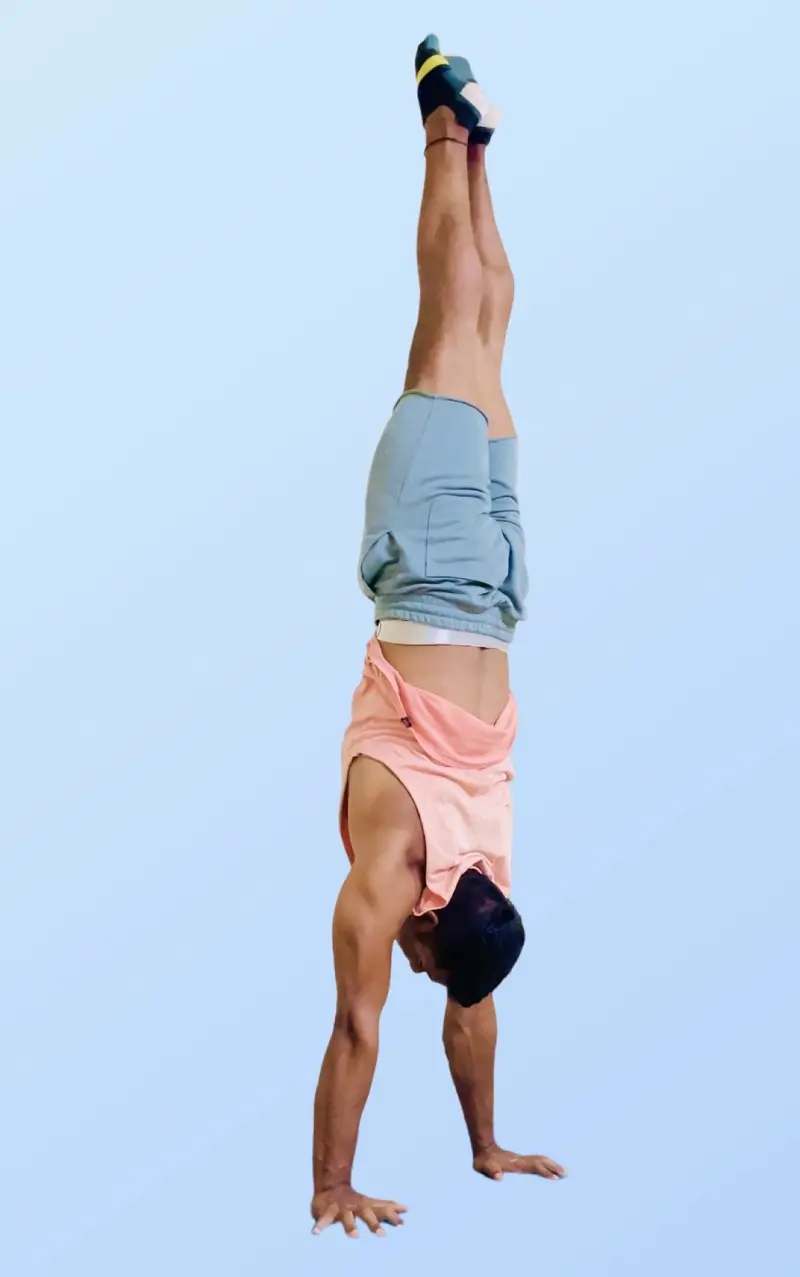
The first handstand goal does not need to be a long freestanding hold. A better first goal is to begin building a practice you can repeat.
That distinction matters. A single lucky balance can feel exciting, but a repeatable process is what allows you to understand your hands, shoulders, body line, entry, and exit. Manoj’s public teaching reflects this progression-based approach. His recent content includes kick handstands, kick-to-wall practice, common kick-to-wall mistakes, strength work, and freestanding practice rather than only finished poses.
Start by respecting the position
Being upside down is unfamiliar for most adults. Your hands become your base, your shoulders have to support and organise the position, and your sense of balance is reversed. Feeling uncertain at first is normal.
The answer is not to throw yourself upward harder. It is to make the experience more understandable.
Begin with an environment where you have room, a stable surface, and a clear plan for coming down. If you have pain, an injury, or a health concern that affects inverted training, seek appropriate professional guidance before practising.
Build the base before chasing balance
Manoj frequently pairs two words: skills and strength. A handstand is a balance skill, but it also asks the body to create a dependable structure.
Beginner preparation commonly includes learning to:
- Put weight through the hands progressively.
- Keep the arms active rather than collapsing into the shoulders.
- Create tension through the middle of the body.
- Understand where the hips and legs are while upside down.
- Repeat short, deliberate attempts without turning every session into a test.
The exact exercises and volume should match the individual. The principle is simple: make the position stronger and more familiar before expecting it to feel automatic.
Use the wall as information
The wall is not evidence that you have failed to balance. It is a training tool.
It can help a beginner spend time upside down without needing to solve every part of the handstand at once. It can also reveal useful questions:
- Are the hands placed consistently?
- Are the elbows staying straight?
- Are the shoulders active?
- Is the body drifting away from the base?
- Can you enter with control instead of crashing into the wall?
Wall practice is most useful when it teaches awareness. If every attempt is a wild kick followed by impact, the wall may be catching the movement without improving it.
Make the kick-up repeatable
Manoj’s content distinguishes between a kick handstand, a kick to the wall, and mistakes made during that entry. That tells us something important: the entry itself deserves practice.
A beginner often assumes the kick has only two settings: too little or too much. In reality, the entry is a coordinated skill. The hands, shoulders, first leg, following leg, and hips all contribute to where the body arrives.
Instead of asking, “Did I hold it?” ask:
- Did my hands land where I intended?
- Did I push through the floor?
- Did the kick feel measured?
- Did I recognise why I came down?
- Could I repeat the same entry again?
Those questions turn attempts into feedback.
“Today’s work. Keep practising. Let’s start handstand.”
Practise balance in small pieces
Freestanding balance is not all-or-nothing. A brief moment of control, a cleaner entry, or a more organised wall position can all be progress.
This is where patience matters. Manoj’s language is rarely complicated: “Today’s work.” “Keep practising.” “Let’s start handstand.” The value is in returning to the work often enough to notice patterns.
Your practice does not have to look advanced to be useful. It needs to be deliberate enough that you understand what happened.
A simple way to think about the journey
The sequence is not perfectly linear, but it helps to organise the process:
- Confidence: become more comfortable supporting yourself upside down.
- Strength: build a dependable base through the hands, arms, shoulders, and trunk.
- Entry: learn to arrive with increasing control.
- Line: organise the body over the hands.
- Balance: recognise and respond to small shifts.
- Shapes: explore tuck, straddle, split, and other positions after the base becomes more reliable.
Start where you actually are
Some students are strong but uncomfortable upside down. Others are flexible but struggle to create tension. Some can hold the wall but cannot control the kick. The right next step depends on the person.
That is the limitation of any article: it can describe the map, but it cannot watch your attempt.
If you want Manoj to understand your current level, send him a short WhatsApp message explaining whether you are a complete beginner, practising at the wall, or already working freestanding. You can also follow the daily practice at @handstand_with_manoj.