A handstand is not only one body shape.
Manoj’s photographs and recent videos show straight positions, tuck shapes, wide straddles, split variations, and arched transitions. Each changes where body mass sits relative to the hands. That makes shape work visually interesting and technically useful.
The objective is not to collect shapes as quickly as possible. It is to explore them without losing the underlying relationship between the hands, shoulders, and balance.
Straight handstand
The straight handstand is the reference point most people imagine: hands on the floor, arms extended, and the rest of the body organised upward.
“Straight” does not mean every body must look identical. It describes the intention to stack the shape efficiently over the base.
This position makes alignment easy to discuss because changes in the shoulders, ribs, hips, knees, and feet are visible. It is also the foundation from which many other shapes become easier to understand.
Tuck handstand
In a tuck, the knees bend and the hips fold, bringing the legs closer to the body.
The silhouette becomes compact, but the balance does not become automatically easier. Moving the legs changes the distribution of mass and asks the student to reorganise without abandoning the support through the hands and shoulders.
Manoj’s content includes tuck practice and several strong tuck photographs. They show that a shape can be both a skill and a way to study control.
Straddle handstand
A straddle opens the legs widely to the sides.
For some athletes, the wide shape can make certain entries or transitions feel more manageable. It also creates a clear visual test of whether the body can change shape while the base remains controlled.
Manoj’s short MP4 sequence includes a striking straddle moment that works especially well as a demonstration of range and expression.
Split handstand
A split handstand sends the legs in different directions, often creating a long, dynamic line.
The split can appear during an entry, as a held shape, or as part of a transition. It introduces asymmetry: one leg may travel forward while the other extends back, asking the athlete to manage different forces without losing the hands as the centre of the balance.
Manoj’s “split to handstand” content and recent video work make this an important part of his visual language.
Arched and scorpion-like shapes
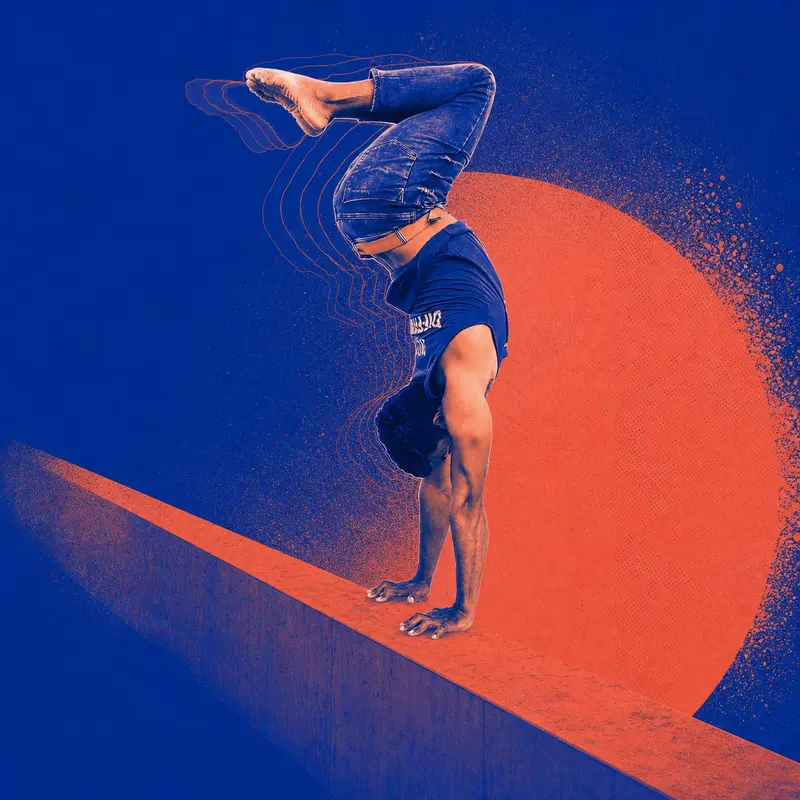
Some of Manoj’s strongest architectural photographs use a deeply arched, compact position. These images are dramatic because the body creates a curve against the straight lines of the environment.
An arched shape should not be treated as a substitute for foundational control. It is a distinct position with different demands. For the website, these photographs belong in advanced and editorial contexts rather than being presented as the first beginner goal.
Shape should reveal control
The most useful question is not, “How many shapes can I do?” It is, “Can I enter, hold, and leave this shape with increasing awareness?”
Changing shape without control can become movement around a lucky balance. Changing shape while understanding the base is a deeper skill.
That is why the Manoj Method keeps returning to the same four ideas:
- Strength to support the position.
- Skill to organise the change.
- Practice to make it familiar.
- Coaching to identify the next useful correction.
To explore which handstand shape fits your current level, contact Manoj on WhatsApp. See his newest shape practice and video sequences at @handstand_with_manoj.