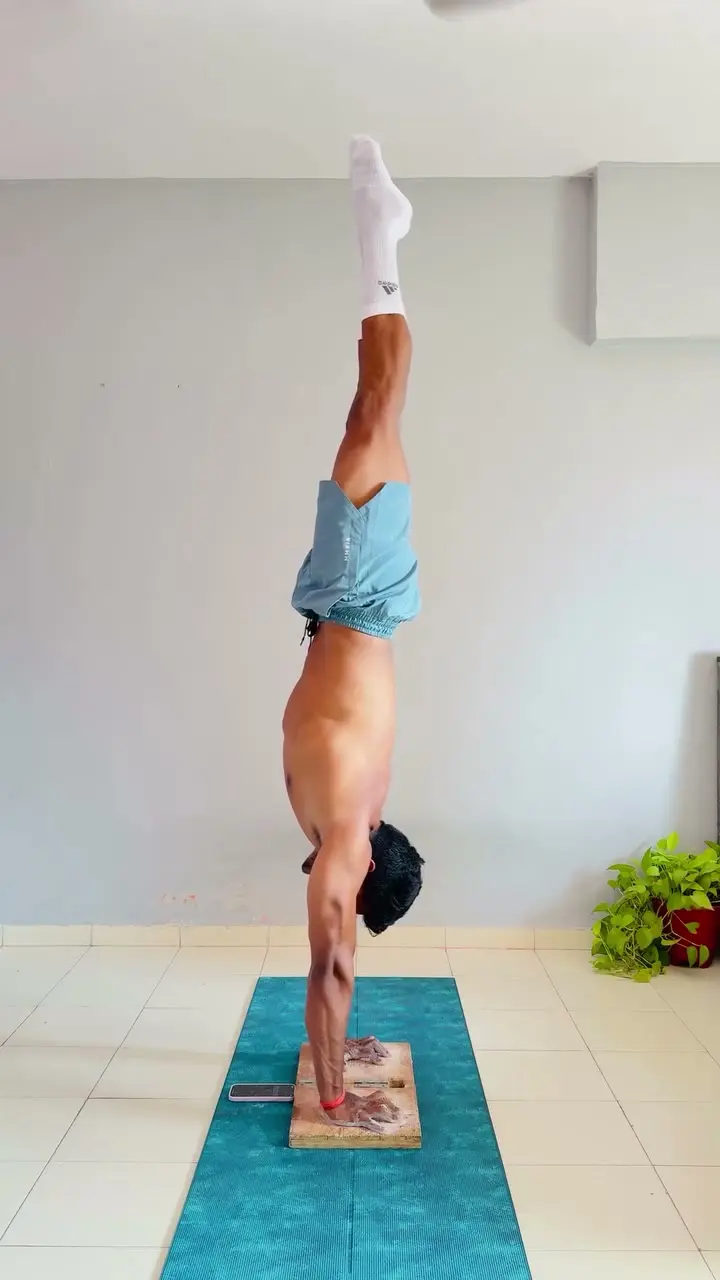
Social media naturally celebrates the finished moment: the long hold, the difficult shape, the handstand in a beautiful location.
Training happens in the less dramatic moments.
It happens when the hands are placed again. When the kick is adjusted. When the wall is used with more control. When the student recognises why the balance moved away.
Manoj’s recent educational content includes the kick handstand, kick-to-wall practice, and common mistakes in that entry. That emphasis suggests a useful principle: the way you enter the handstand is part of the handstand.
The entry determines what you have to solve
When a kick-up arrives with too much speed, the body immediately has to stop that momentum. When it arrives without enough commitment, the hips may never reach the base. When the hands, shoulders, and legs are not coordinated, every attempt can feel like a different problem.
A repeatable entry reduces noise. It gives the student a similar starting point from which balance can be understood.
This does not mean every kick must look identical. It means the attempt has enough intention that you can learn from it.
The wall should teach, not merely catch
The wall can make inversion more accessible, but contact with the wall is not the only objective.
Useful wall practice helps you notice:
- How much force the entry actually needs.
- Where the shoulders are relative to the hands.
- Whether the body is organised or folding in several places.
- Whether you can reduce dependence on the support over time.
If the wall receives a heavy impact on every attempt, the practice may be rehearsing excess force. If the student is afraid to reach the wall at all, the entry may remain hesitant. Coaching helps find a more useful middle ground.
Mistakes are information
A mistake is not automatically a bad session.
The important question is whether the mistake becomes visible. Did the hands move? Did the leading leg travel too aggressively? Did the shoulders soften? Did the body rotate away from the intended line?
When the cause becomes clearer, the next attempt can have a purpose.
This is one of the differences between random repetition and practice. Random repetition asks the same general question: “Will I hold it this time?” Practice asks a more specific one: “Can I change this part?”
Build the impressive result quietly
Advanced shapes are still worth celebrating. Manoj’s own profile includes tuck positions, split entries, handstand push-ups, planche, and one-arm-handstand work. But those results sit on top of many ordinary sessions.
“Today’s work” may not always produce a new personal best. It can produce a more accurate kick, a stronger shoulder position, or a better understanding of the exit. Those changes are easy to overlook and important to keep.
What to look for in your next session
Choose one question rather than judging the whole handstand at once:
- Can I place my hands consistently?
- Can I make the entry quieter?
- Can I recognise when I am using too much force?
- Can I keep pushing through the floor?
- Can I describe why the attempt ended?
A clear question gives the practice direction.
For feedback on your own kick-up or wall practice, contact Manoj on WhatsApp. For current demonstrations and training clips, follow @handstand_with_manoj.