Online handstand coaching should be more than receiving a list of exercises.
A useful coaching relationship begins with observation. The coach needs to understand what you want, what you have already tried, where the movement breaks down, and what your body is currently prepared to do.
That is how Manoj approaches the process.
The first step is a conversation
Before choosing exercises, Manoj asks questions.
- What skill are you trying to learn?
- Have you attempted it before?
- Where do you currently get stuck?
- Why are you looking for coaching now?
- Do you already do strength training?
- Are you a complete beginner, intermediate, or advanced athlete?
- Is there pain, injury, or a medical condition that could affect inversion?
The goal is not to make the intake process complicated. It is to prevent a generic program from being applied to the wrong starting point.
Two students can want the same handstand and need very different work.
Show where you are, not where you think you are
Self-description is useful, but movement gives the coach more information.
Manoj may ask a student to demonstrate a kick-up, wall handstand, freestanding attempt, or relevant strength movement. Online, this can happen live on camera or through a submitted video.
The purpose is not to judge whether the attempt looks impressive. It is to identify the next useful step.
A video may reveal that the primary limitation is:
- Entry consistency.
- Confidence moving upside down.
- Wrist or shoulder tolerance.
- Strength in the supporting position.
- Mobility required for a clearer line.
- Ribcage and pelvis organization.
- Balance correction through the hands.
- A foundation that was skipped earlier.
Assessment turns “I cannot hold a handstand” into a more specific, trainable problem.
Your program begins from your real starting point
Manoj does not describe his method as picking random exercises and giving them to everybody.
He builds the structure around the student. If your previous training is sound, the program can continue from where you stopped. If an important foundation is missing, he may deliberately take you backwards before moving forward again.
That is not lost progress. It is a way to make later progress more dependable.
The program may combine:
- Handstand practice appropriate to your current level.
- Supporting strength work.
- Mobility for the positions you need.
- Alignment practice.
- Entry and exit drills.
- Shape or balance work for more advanced students.
The mix changes according to the person.
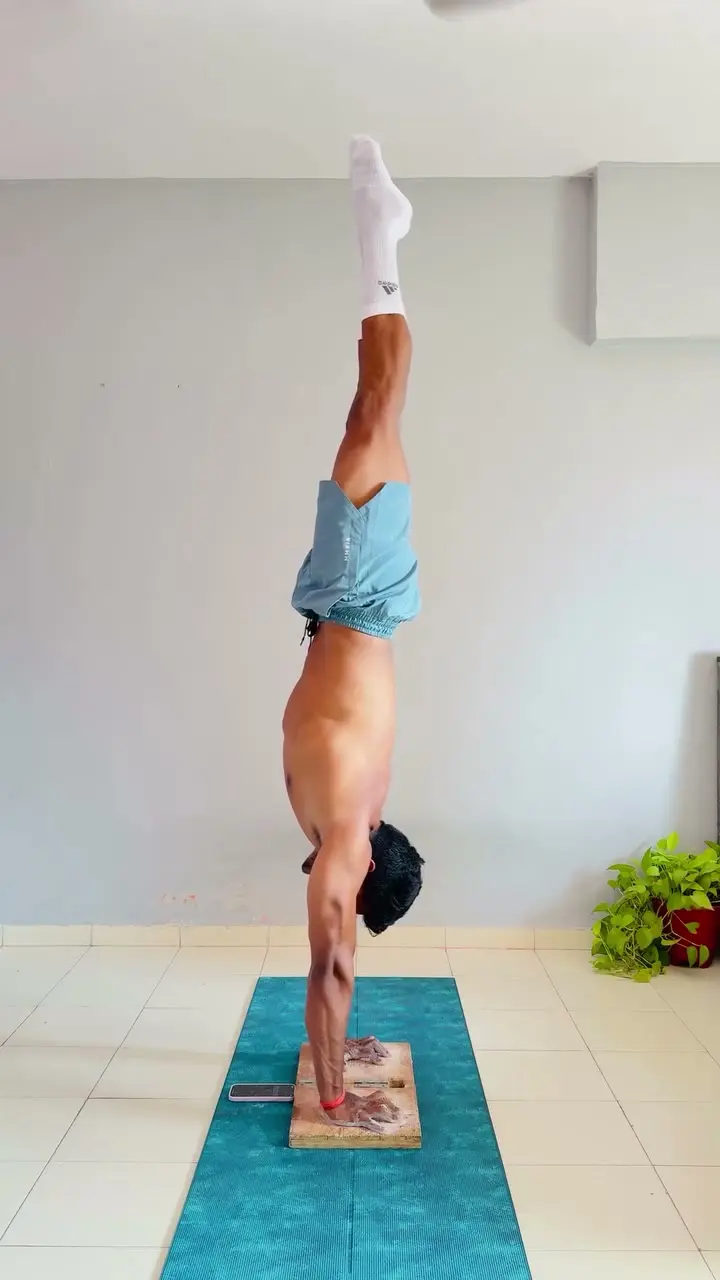
Manoj demonstrates the movement himself
Online coaching does not remove demonstration.
If Manoj wants you to perform a drill, he can show it on camera so you can see the setup, direction and intention. This helps clarify details that can be difficult to communicate through exercise names alone.
You are not expected to decode a program without context.
Video feedback makes corrections visible
Students can send photographs or videos of their attempts. Manoj can respond directly, draw reference lines over an image, point to the position that needs attention, and explain the relevant muscle or muscle group.
This creates two kinds of feedback:
- What to change: the practical correction for the next attempt.
- Why it matters: the movement, alignment, or muscular reason behind it.
Education is part of the coaching. Over time, the student should become better at recognizing positions rather than depending forever on an external cue.
The plan remains consultative
Programming is not finished when the first document is sent.
You practise, report what happened, share the relevant footage, and explain what you felt. Manoj then uses that information to adjust the work.
This is particularly important if you experience pinching, impingement, or pain. Manoj does not want students to hide those sensations and continue blindly. Training may need to change, pause, or be referred to an appropriate medical or rehabilitation professional.
How often should you work on the skill?
For serious skill acquisition, Manoj prefers at least two sessions per week and considers three ideal. Some students work with him five times weekly depending on their goals and overall program.
Frequency does not guarantee an outcome. It creates enough opportunities to practise, receive feedback, adjust, and reinforce what you are learning.
Who can begin online?
You do not need an advanced starting point. Manoj works with students ranging from complete beginners to advanced athletes. Even somebody who cannot currently do one push-up can begin at an appropriately scaled level.
Online coaching still has boundaries. Significant wrist, elbow, or shoulder problems, severe migraines affected by inversion, injuries, or medical conditions may require clearance or care from the appropriate professional before inverted training.
Start with an honest snapshot
The most useful first message is not “Can you make me do a handstand?”
It is a clear snapshot:
Here is where I am. Here is what I have tried. Here is what I want to learn.
Send Manoj that information on WhatsApp, along with a short video if appropriate, to begin the conversation.